Hunger motif
Lazarillo de TormesThe hunger motif is the central material force in Lázaro de Tormes’s life: it trains him in the ingenuity needed to survive, exposes the cruelty and hypocrisy of those who control food, and sets the measure by which he judges both masters and fortune. It begins as bodily deprivation, becomes a spur to deception and work, and shadows the apparent prosperity he eventually earns. In this harsh education, food is never merely a symbol: bread, meat, alms, and saved wages determine what Lázaro can do next.
Hunger as an Education
Lázaro’s first service, under the blind man, initiates what the narrative presents as a grotesque education. The blind man’s lesson at the stone bull teaches the boy that he must learn to protect himself in a hostile world; hunger supplies the daily pressure behind that learning. Their relationship becomes a contest between the master’s vigilance and the boy’s increasingly practiced resourcefulness. Lázaro sometimes wins food through cunning, but the blind man usually answers with punishment. The contest ends in a reversal: Lázaro uses a collision to repay the blow with which his master began their association, demonstrating that he has learned the practical lesson of the apprenticeship and can leave for new adventures.
That apprenticeship is visible in the precise tactics hunger produces. The blind man keeps bread and other provisions in a cloth bundle secured by an iron ring, a padlock, and a key. Lázaro eats the small ration given to him in a couple of bites, then unpicks and resews a corner seam to steal larger pieces of bread, bacon, and sausage while his master is distracted. The theft is a response to an avarice that leaves him without enough to eat, not a one-off trick: hunger makes close observation, timing, and concealment part of his everyday survival.
Food Withheld and Food Taken
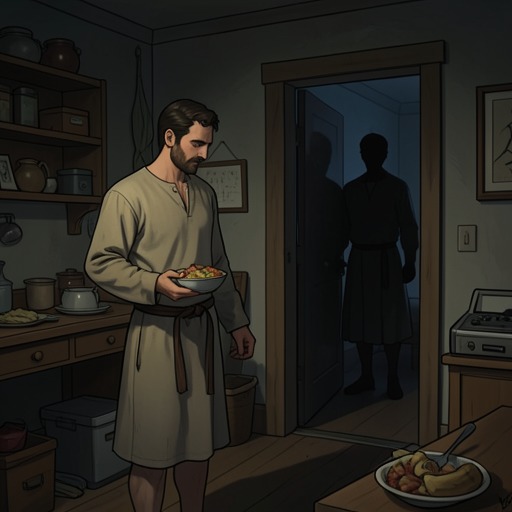
Under the priest, deprivation takes a different form. The priest claims that religious men should be temperate, but Lázaro observes that he eats and drinks heartily at confraternity prayers and funeral vigils when the meal is paid for by others. At home, the priest’s restraint is imposed chiefly on his servant. The daily provision for meat is five blancas between lunch and dinner; the priest shares the broth but keeps the meat, leaving Lázaro less than half the bread he needs. On Saturdays, Lázaro buys a sheep’s head for three maravedís. His master eats the eyes, brain, and meat around the jaws, then puts the picked bones before the boy as if they were a generous serving.
The contrast between public feasting and private denial makes hunger a means of exposing hypocrisy as well as a physical condition. Lázaro is so ravenous that he hopes each day will bring a death and a funeral vigil, where food is plentiful enough to fill him. When the priest carries the sacraments to the sick, Lázaro prays fervently for the sick person to die; he later says that in roughly six months, twenty people died, and imagines that his prayers had brought their deaths. His grotesque account makes a meal at a wake the measure of his desperation: he welcomes the dead as providers because his living master will not feed him. Yet the feast is temporary. On days without a funeral, he returns to ordinary starvation, and he even longs for death for himself, though it never comes.
Hunger also determines the risk of leaving. Lázaro considers abandoning the priest but fears that weakness has left him too frail to rely on his own legs; he also worries that another master could prove worse. When he does move on, the next master tells him that he has already eaten breakfast and will not eat again until evening. Lázaro nearly faints, not only from hunger but from the renewed certainty that fortune is against him. He remembers his earlier miseries and cries over both the past and the death he believes is near. Still, he conceals his condition, presenting himself as a boy who is not troubled by food. The performance reveals how hunger shapes not only his body but also what he can safely admit to a potential master.
Poverty, Sympathy, and Survival
With the poor squire, hunger creates a reversal in the usual relation between master and servant. After eight or ten days, the squire goes out each morning with a stately step and his nose in the air, while Lázaro begs for him. Lázaro recognizes that he has escaped masters who were stingy with food only to find one who cannot maintain him and must instead be maintained by him. Yet he feels genuine pity rather than resentment: the squire has nothing and, as Lázaro sees it, cannot do otherwise. There are times when Lázaro brings home enough to feed his master only by leaving himself barely fed. Hunger remains severe, but it no longer produces the same hatred he directs toward masters who have resources and refuse to share them. His judgment distinguishes deprivation from deliberate withholding.
That household’s poverty soon becomes a question of debt as well as food. A man arrives to demand the rent for the house and an old woman demands payment for the bed; the two months’ charges together exceed what Lázaro expects the squire could earn in a year. The squire promises to change a coin at the market and asks them to return in the evening, then disappears without returning. Lázaro is left behind with the key, frightened to spend the night alone and dependent on the neighbors for shelter. Hunger belongs to a wider material vulnerability: unpaid lodging and flight leave the servant, rather than the debtor, to face the creditors.
From Hunger to Wages
The narrative makes resourcefulness an answer to deprivation, but not an escape from poverty that arrives all at once. While serving the priest, Lázaro thinks continually about how to keep himself alive. One night, hearing his master snore, he takes a knife he has hidden safely and uses it like a drill on the old, worm-eaten chest that holds the bread. He cuts a hole where the wood is weakest, reaches inside, and removes some of the bread already cut. The chest’s age and decay make the plan possible; hunger converts that detail into an opportunity. The next day, even after the priest repairs the damage, Lázaro takes a little more. His own reflection that need is a great teacher gives the episode its wider meaning: necessity sharpens his ingenuity, while satiety would blunt it.
A more durable change comes when Lázaro finds work selling water in the city. A chaplain gives him a donkey, four jars, and a whip. The job satisfies his stomach and creates a modest but regular arrangement: each day he pays his master thirty maravedís from his earnings and keeps the remainder, along with everything he makes on Saturdays. For the first time, hunger is answered not by stealing a meal or hoping for a funeral, but by work that allows him to retain part of what he earns.
Over four years, he safeguards enough of those savings to buy second-hand clothes that let him present himself as a respectable man: an old fustian doublet, a worn shirt with slashed sleeves, a once-trimmed cloak, and an old sword. This is a real improvement in resources and appearance, but it is measured and hard-won, not an effortless rise out of deprivation. Once he sees himself dressed as a man of standing, he tells the chaplain to take back the donkey because he no longer wants to continue the trade. The long movement from a boy who steals food to a worker who saves wages gives material shape to his ascent, while the worn clothes and second-hand sword keep its limits in view.
Narrative Significance
Hunger links Lázaro’s separate encounters into a continuing education in survival. Its form changes with each household: the blind man’s locked bundle prompts theft and counter-cunning; the priest’s controlled meals and paid-for feasts expose the difference between professed temperance and actual appetite; the squire’s empty purse turns Lázaro into a provider; and the water-selling job converts food into wages, savings, and clothing. These episodes do not describe a simple climb from misery to comfort. Each new arrangement carries a distinct danger or compromise, and even the most reliable one requires years of work and careful saving.
The motif also clarifies the irony of Lázaro’s eventual success. The adult’s claim to have risen through the world rests on an education formed by scarcity, in which the cleverest response to hunger is often a trick against someone with more power or property. Yet the story also distinguishes the stinginess of the blind man and priest from the squire’s inability to provide: poverty can provoke anger, pity, or a change in Lázaro’s role, depending on its circumstances. Hunger is therefore both a bodily emergency and the practical measure of social relations. It teaches Lázaro how to read other people’s resources, how to hide his own need, and how narrow the passage is from being fed by another to earning enough to feed himself.